


Updated: Feb 8
Tathālokā Therī
February 6, 2026
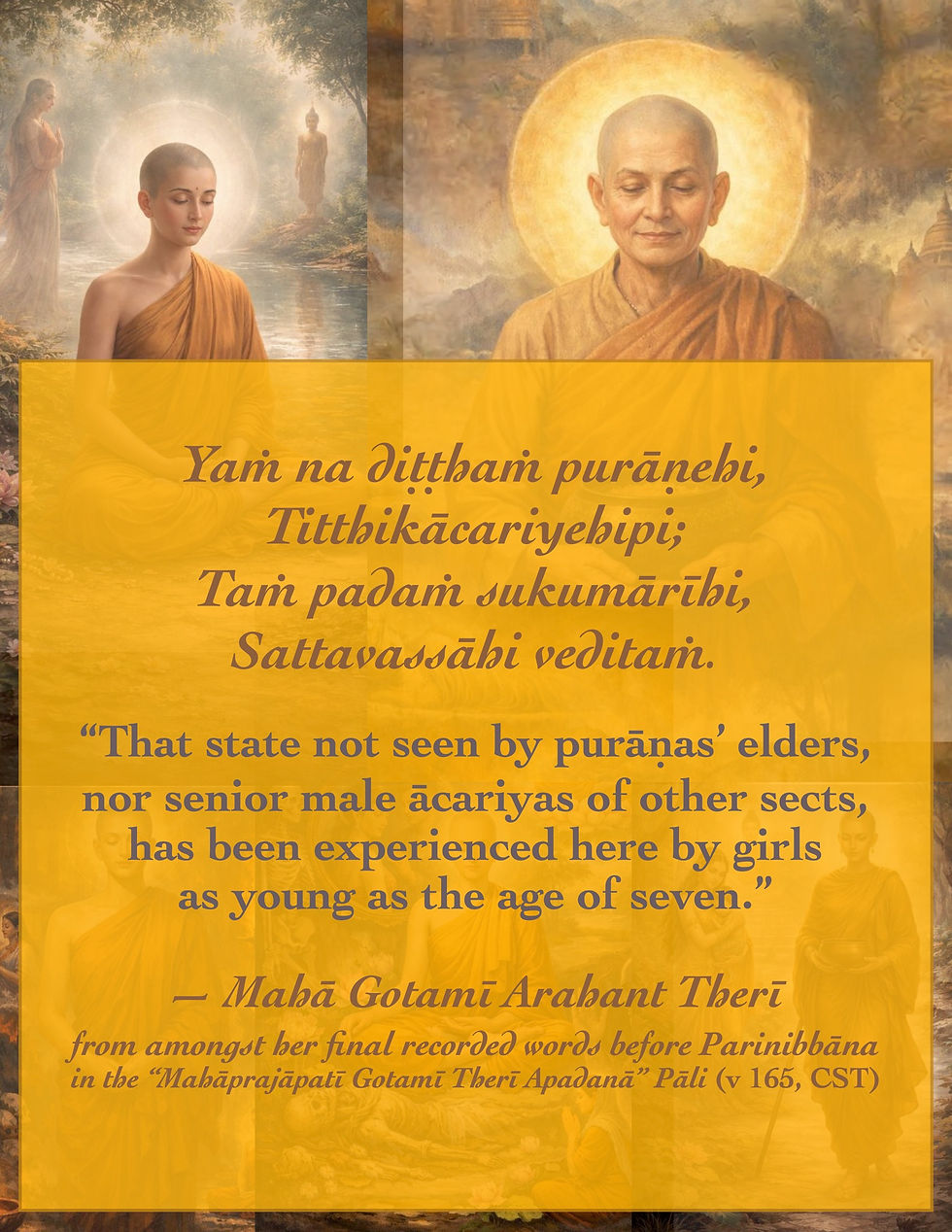
"Girls as young as age seven"
. . . special dedicated post no. 4 of 7. . . offered in honor of the final 7 days teaching of Mahā Gotamī leading up to her Parinibbāna 🌗✨ Feb 8th-9th
. . .
Belatedly my fourth post -
I have been thinking about young girls, and as a historian, herstorian or ourstorian, there is a lot to consider. As it is the anniversary commemoration days of the final seven days of Dhamma teachings of the 'Buddhamātā,' founding mother of the Bhikkhuni Sangha, and it's first arahantī, I thought to share something attributed to her:
❛❛Yaṁ na diṭṭhaṁ purāṇehi,
Titthikācariyehipi;
Taṁ padaṁ sukumārīhi,
Sattavassāhi veditaṁ.
❛❛That state not seen by purāṇas’ elders,
nor senior male ācariyas of other sects,
has been experienced here [in the Buddhā Sāsana]
by girls as young as the age of seven.❜❜
— Mahā Gotamī Arahant Therī
from amongst her final recorded words before Parinibbāna
in the “Mahāprajāpatī Gotamī Therī Apadanā” Pāli (v 165, CST)
This verse is from the Mahāpajāpatī Gotamī Therī Apadāna, a canonical Pāli text also preserved in the Pāli manuscript traditions, as well as twice in the Chinese translations of the Tripitaka and at least once in Tibetan translation. The verse i've shared here appears to have been a popular one, as we can find it referred to in ancient quotes as a point of pride among Buddhists. Clearly, in the context here, it is a point of pride for Mahāpajāpatī Gotamī Therī too, in her final reflections before her penultimate nirvāna, parinibbāna.
✤ HOW OLD WAS THE YOUNGEST RECORDED BUDDHIST FEMALE ARAHANT?
Some traditional Buddhist monastic teachers i've heard say that this verse refers to the famed Mahā Upāsikā Visākhā, who in her well known and often told life story attains to stream-entry (soṭapanna) upon encountering the Buddha and hearing his teaching at the tender age of seven. (A stupa was built at this place, which still exists.)
She later goes on to be one of the Buddha's foremost leading women disciples, on the list of the Top Ten Upāsikā Mahā Sāvikās - all of whom had opened the Dhamma eye, seen Nibbāna for themselves, and entered the arahant path, with noble attainments in path and fruits.
Some others say that this refers to the youngest bhikkhunī arahantī whose story is told in the Therī Apadāna. Her name is Selā the Āḷavikā, and according to the commentaries, she is also known as known by the nicknames of Pañcadīpikā Therī and Pañcadīpadāyikā Therī, which means "She of Five Lamps" or "She, the Giver of Five Lamps."
Verses attributed to her appear in four-five places in the Pāli-text Tipitaka. These are the relevant verses from the Therī Apadāna:
❛❛Pacchime bhave sampatte, mānasaṃ vinivattayiṃ;
Ajarāmataṃ sītibhāvaṃ, nibbānaṃ phassayiṃ ahaṃ.
Jātiyā sattavassāhaṃ, arahattamapāpuṇiṃ;
Upasampādayī buddho, guṇamaññāya gotamo.❜❜
❛❛Coming then to my final life,
I turned my mind away from the cycles of repeating
the same things over and over again;
I touched Nibbāna for myself,
the cool state, free from aging and death.
It was at the age of seven years since my birth,
that I attained to arahantship.
The Buddha then gave me upasampadā higher ordination,
Gotama, recognizing and knowing my virtue.❜❜
- Selā Therī, Pañcadīpikātherīapadānaṃ vv 1.9, 107-108 (CST)
and Pañcadīpadāyikātheriyāpadānaṃ vv 2.5, 77-78 (CST)
This is quite outstanding and remarkable. But there are likewise famous stories of male novices (sāmaneras) attaining to arahantship, and then by virtue of this, being accepted by the Buddha as a bhikkhu. And this seems to have been her case here as well.
✤ AGE SEVEN
Traditionally male and female novices (sāmanerīs) are not accepted before the age of seven, or until they are 'old enough to scare away crows.' This normally means that they are old enough to be quite capable, and often falls between ages 7 and 10. Twenty plus years ago, I saw many male novices in Thailand who were highly capable around the temple. I was surprised. I had also seen this among kids when i lived in the countryside in rural northeastern Washington State, when the kids on the ranches, both boys and girls, were capable with chores from a young age.
Years ago, wondering after this verse, I did a Google search, to see if there was any special development in children around the age of seven. Indeed there is. Learning about it, it was tremendous! - for both boys and girls.
✤ DIFFERING IDEAS, EXPECTATIONS & OPPORTUNITIES
I reflected back on my own childhood. Living in the countryside, between age 6 and 7 was the beginning of our independence in a way - because we started going off to school by ourselves. By the second year of this, we knew the ropes pretty well.
Because of my parents' travels, I also got to experience a variety of different learning environments and situations - with vastly different concepts of what we were there for, and what was expected of us. Our opportunities were molded by these concepts.
By the time we began entering puberty, everything changed, and we began to be 'fast-tracked' in some places into the stages of entering the adult world as if on a conveyor belt. While in other places, there was the wish to shelter and protect us, and to nurture us as unique individuals of unique talents and capabilities, and to give us the precious time and space to learn and grow.
✤ BUDDHIST APADĀNAS & AVADĀNAS
The 'heroic biography' or 'hagiography' genre of the Pāli-text Apadānas has a rough parallel in (perhaps later) Sanskrit Buddhist Avadāna texts. In the Avadānas, there is a whole genre dedicated to precocious / savant young women (or girls) who were betrothed (or married) very young, and who strongly wished to enter the Buddha's Sangha and ordain instead. In the Apadānas, the final and penultimate Sumedhā Therī Apadāna tells one such story. The Sanskrit Avadānas and the Sumedhā Therī Apadāna tell their success stories. It appears that, as child marriage became increasingly common, that sharing these heroic stories of such young women became increasingly important.
✤ PRECOCIOUS YOUNG WOMEN / GIRL SAVANTS
Someone might notice i write 'young women' here, and call that into question. In the Indic language traditions, there are 'kumaris', who are are not-yet-married maidens or virgins, and there are married females. While in the Buddha's time and area, 16 was considered an ideal age for marriage of both young men and women, and the Buddha and Yasodharā are said to have married at age 16. Later in other times and places, marriage of girls become common at age 10-12. There were Brahmin rules which made it a fault (considered a type of killing) for fathers not to have seen their duaghters married by the time of their first menses.
✤ SIKKHAMĀNĀ TRAINING
In our Bhikkhunī Vinaya, we have the provision to accept young married women (girls) from the age of 10, for a highly level of training as compared to sāmanerīs. This higher level of ordination is called sikkhamānā, and it is a 2-year period of probationary training, which can be extended as long as needed be. If this training (sikkha) was undertaken by a young married woman or girl at age 10, and successfully completed within 2 years time, she could apply for and receive higher ordination (upasampadā) as a bhikkhunī, from the age of 12. That is surprisingly 8 years earlier than the allowance for young men and boys, for whom the minimum age of higher ordination is 20.
In explaining this, the elder monks said: women married young mature and become capable quickly. They also said: long ago, both boys and girls began schooling at a young age, taking initiation with an accomplished teacher or guru, learning apprenticeship-type training, with a system of daily oral instruction and lessons.
However, later, with the invention and spread of writing, except women and girls of royal families and the very upper classes, this system of initiation and away-from-home schooling came to be increasingly available only to boys. Thus the sikkhamānā training time, could have been a time of remedial education for young women and girls in Buddhism, such that they would be prepared for the level of learning, memorization, practice and teaching that was the norm of the Buddhist Bhikkhu-Bhikkhuni Sangha. Unmarried women and girls from the age of 18 were allowed to apply for sikkhamanā training and receive sikkhamānā ordination from the Bhikkhunī Sangha.
There was no comparable sikkhamāna training and ordination offered to men and boys under age 20, only novicehood.
We may note again that the sikkhamānās had a higher status than both male and female novices (sāmaneras and sāmanerīs).
The history is still vague and we are awaiting a proper multi-traditional historical study of this topic to gain a better understanding of it.
✤ OVERVIEW
Nonetheless, we gain a sense that in Buddhism, young women and girls were seen as capable - not only of being married (which included arranged marriages, and self-chosen marriages, and even just running away together) - but both capable and worthy of self-determination, of full support for education, and of all stages of awakening in the noble Path taught by the Buddha, up to and including arahanta.
The differing ideas, and diversity of ideas, of young (and elder) women's and girls' capability and suitability back then, as evidenced in our old Buddhist texts, bear remarkable similarities to what i experienced in my young life.
Mahāpajāpatī Gotamī shows with great determination, that even an 80 year old who lived the pampered life of a queen, is capable of going forth (even walking 200 miles/300 kms) and of attaining the very highest in the Buddha's teaching, living a life of tremendous worth, meaning and value.
Upāsikā Visākhā and Bhikkhunī Selā (Pañcadīpadāyikā) show us that girls as young as seven can attain stream entry and even arahanta, and that this was a matter of great pride for ancient Buddhists.
The concepts we hold of our meaning, value, and capabilities profoundly shape our self-views, our perception of others, and our sense of meaning, value and worth, and our efforts in this world.
"The Buddha, seeing my virtue and qualities, gave me higher ordination (upasampadā)." - Selā Arahant Therī
"Young girls, even at the age of seven, have attained what white-haired elder (male) rishis and ācariyas of other traditions could not yet see and experience, here in the Buddha's Teaching."
- Mahā Gotamī Arahant Therī
✤ SELF-REFLECTION
I ask myself: how does this inform my view of our present circumstances in our society and world? How does this inform how i see others around me? What is the moral imperative?
Bowing to the potential in all of us, with heart interest to see the world through the Buddha's eyes, and the eyes of those 'awakened in the wake of the Awakened One,' the sāvikā buddhās,
Namo Buddhāya
Namo Ratanatrāya
✍️ Tathālokā Therī at Dhammadharini
*offering the fourth of seven offerings in commemoration of the final seven days of teaching of our most venerable founding mother, first fully awakened bhikkhunī, opening the path for so many others
. . .
✤ CREDITS
AI painting images of arahant therīs here are thanks to the wonderful posts of Dr. Vikas Singh with anumodana.
The Pāli text is from the Igatpuri VRI Vipassana Research Institute's CST Chaṭṭha Saṅgāyana Tipiṭaka (the Sixth Council Edition) aka 'BE' (the Burmese edition) at www.tipitaka.org.
I've consulted with the English translations of the Therī Apadāna by Jonathan Walters, and of the Paramatthadīpanī Therīgāthā Aṭṭhakathā by KR Norman for the Pāli Text Society.


